
I did not start with digital. Nobody did, when I started.
I started with film — with the smell of a darkroom, with the discipline of thirty-six frames and no do-overs, with the particular quality of attention that comes from knowing every frame costs something. Film was all there was. Then digital arrived and changed everything, and I went along with it because you had to, and because digital is genuinely powerful and I am not going to pretend otherwise.
But I never fully left film. And over the twenty-five plus years of working in both, I have come to understand some things about photography that I do not think I would have learned the same way if I had started in the digital era.
These are those things.
The Camera Is Your Paintbrush, Not Your Subject
When I am teaching, I say this a lot: the camera is your paintbrush. It is the tool you use to show the world how you see it. That sounds simple but it is easy to lose sight of.
Film made this obvious to me because film demanded that I know my tool. I could not spray and pray. I had to understand what my camera would do in a given situation before I pressed the shutter. I had to know how the film would respond to light. I had to make decisions in advance because I would not be able to correct them afterward.
That necessity produced a relationship with the camera as a tool — not as a magic box that produces images, but as an instrument that executes the decisions of the person holding it. The camera does not see. I see. The camera records what I see, within the parameters I have set, at the moment I choose to press the shutter.
When that relationship is clear, everything about photography gets simpler. You stop expecting the camera to do the creative work and start understanding that the creative work is yours to do first. The camera is just how you express it.
Patience Is a Technical Skill
This one took me a while to understand.
I thought patience was a personality trait — something you either had or you didn’t. Some photographers were patient by nature and waited for the right moment. Others were impatient and settled for whatever was there.
Film taught me that patience is something you practice. It develops through the repeated experience of waiting and having that waiting produce something, versus rushing and seeing in the developed images exactly where the rush shows up.
The moment before the expression settles into something real. The light three minutes before it is perfect rather than when it is almost perfect. The gesture that is about to happen versus the one that just finished. All of those things require patience not as a passive quality but as an active practice — the decision to wait, made in a specific moment, based on your read of what is about to come.
Film trained that practice in me because there was no other option. The cost of a frame I was not ready for was real. The discipline of waiting until I was ready became a habit that followed me into digital shooting. It is one of the most valuable things film gave me.
Imperfection Is Information
There is a grain in film that digital noise is not. This is not just an aesthetic statement — it is a technical truth about how film grain and digital noise are produced and how they behave visually.
But beyond the technical distinction, film taught me something about imperfection more broadly. A slightly soft frame on film does not feel like a failure the way a slightly soft frame on a high-resolution digital file does. A color shift in an old emulsion does not feel like a mistake — it feels like a characteristic. A light leak in a camera with imperfect seals produces something unpredictable and sometimes beautiful.
These imperfections taught me to distinguish between errors worth fixing and characteristics worth understanding. Not everything that is not perfect is a problem. Some imperfections carry information about the process, the light, the equipment, the moment. Learning to read imperfection rather than immediately trying to correct it made me a more thoughtful editor and a less anxious photographer.
I photograph differently when I stop expecting perfection and start expecting information.
You Are Looking for a Feeling, Not a Setting
This is the thing I feel most strongly about and the thing that took me the longest to be able to say clearly.
There is technically correct exposure. There is a formula that gives you it. I know the formula. I never teach it, because it does not teach your artistic style. It teaches you to produce what the formula produces, which is technically correct, which is not the same as right.
What I am looking for when I photograph is a feeling. The feeling of late afternoon light when it goes warm and long. The feeling of a dark interior with one window source. The feeling of a subject who has forgotten I am there. Those feelings have exposure values, but I do not arrive at them through calculation. I arrive at them through looking at the light, making a decision, shooting, and seeing whether the result matches what I felt in the moment.
Film trained me to develop that felt sense of exposure because I had to commit to it without the safety net of immediate review. After thousands of rolls, I developed an intuition for what exposure produces which result, and that intuition is not separable from the emotional quality I am trying to create.
Everybody sees light differently. Everybody responds to shadow differently. The point of learning exposure is not to produce technically correct images. It is to learn to use your tool the way you see the world. Film gave me the environment where that was the only option, and I am grateful for it.
Where This Leads
Twenty-five years in, I am teaching film to students who never shot it. Watching them slow down, actually look, make deliberate decisions, wait for the moment — and then receive their developed images and see something they were not sure they had captured — is one of the more satisfying parts of this work.
Film teaches photography in a specific way. It removes the shortcuts. It demands presence. It produces a relationship with the craft that is different from what you get when instant review and unlimited capacity are available.
If you are curious about starting and want a simple, practical starting point — what film to use, what to prepare for, how to get your roll developed — the free 35mm Starter Checklist has everything you need to get your first roll through a camera without the guesswork.
And if you want to go deeper into the longer arc of what building a creative practice actually requires — the patience, the discipline, the willingness to stay in it through the uncertain middle — Before You Call It a Photography Business covers that honestly.
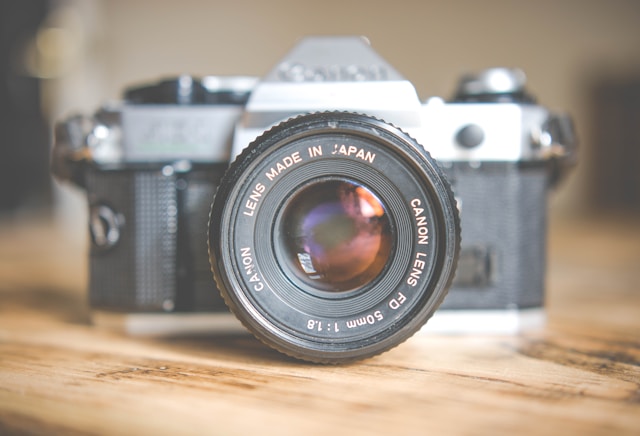
The film camera on my shelf is not a relic. It is still a working tool.
I still shoot with it.
And every roll still teaches me something.